

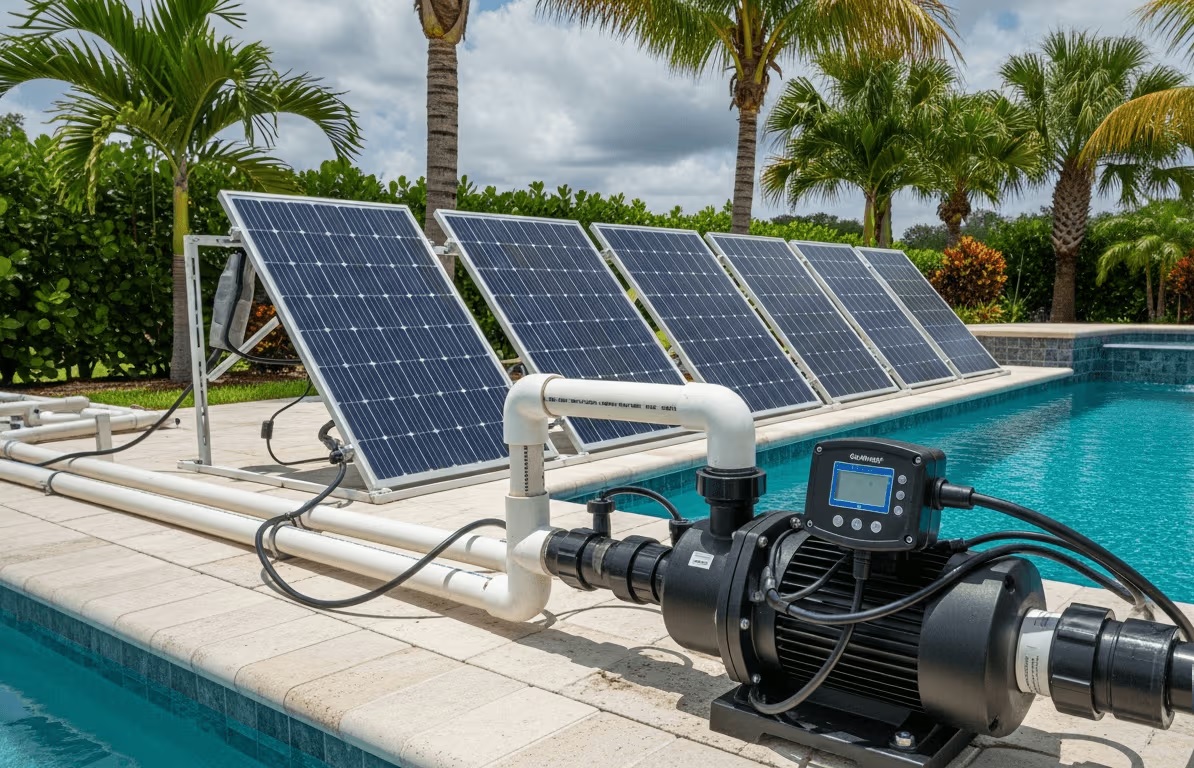
Many homeowners believe that their pool is a costly investment due to the chemicals, cleaning, and sporadic repairs. However, the most significant expense is the one they don’t hear – the pump motor churning away 24 hours a day. Replacing your pool’s mechanical equipment – beginning with the pump, but not stopping there – is one of the best-return maintenance and comfort decisions a homeowner can make.
Why Single-Speed Pumps Are An Energy Problem
A regular single-speed pool pump operates at about 3,450 RPM. Each time it runs, it runs at full blast. It does not throttle back for a quiet Tuesday morning when the pool is not in use. It just runs, wide open, for eight to twelve hours.
Pool pumps are the second-largest household electricity consumer after your air conditioner. And because your pool needs to run most during the hottest months, those costs multiply.
The stupid thing is, your pool doesn’t need full flow most of the time. Filtration doesn’t require the hydraulic power that vacuuming or the spa jet does. But a single-speed pump can’t tell the difference. It will give you all the beans, all the time – and you will pay for every watt of the excess.
The Physics Behind Variable-Speed Savings
Upgrading to a variable-speed pump (VSP) isn’t just a small improvement – the energy math is quite impressive once you understand the underlying mechanisms.
Centrifugal pumps function under the Affinity Laws, which are a group of principles from fluid mechanics that detail how pump speed, flow rate, and power correlate. The cube law is the principle that applies here: the power required will be the cube of the speed of the pump. In practical terms, this means if you drop the pump speed in half, you don’t cut the power take in half – you drop it to an eighth.
Apply that: a pump running at half speed to create a nice, slow turnover rate for filtration uses about 87.5% less power than it would running at full speed to accomplish the same task over a longer run time. In other words, you can run the pump twice as long at half the speed and still use a fraction of the power.
This is why variable-speed pumps pay for themselves. According to the U.S. Department of Energy, upgrading to an ENERGY STAR certified variable-speed pool pump can save a homeowner up to $340 a year in electricity costs, with the unit paying for itself in less than two years. For most people, that’s a better return on investment than any other home reno spending.
Sizing and System Assessment Matter More Than Most People Think
The performance of a variable-speed pump is directly related to the quality of its installation. You may have purchased a high-efficiency motor and matched it with a state-of-the-art controller, but if you wire it into an under-sized plumbing system, a filter that’s clogged more often than not, or a pool with a poorly configured pipe layout the estimated 80% savings is mostly lost to hydraulics.
Before you even think about ordering a new pump, the best place to start is knowing your specific system’s Total Dynamic Head (TDH) – which is quite simply the total resistance your pump must defeat in order to circulate water through the full loop of pipes, valves, fittings, and filter media.
This means your low-head pump may be just tossing its impeller against a brick wall for all it’s accomplishing in a high-resistance hydraulically over-piped system. Or conversely, your high-head pump spins away burning up electrical power like nobody’s business in a low-resistance system that offers so little pushback it’s like pumping water down a sunlit country stream. Either way, you’ve just squandered a big slice of the promised energy savings.
Again, this is where a bit of professional help can pay big dividends. Have specialists like Shenton Pumps size your new variable-speed pump against your actual system specs and map your existing TDH for you. They can help you identify where and into what the hydraulic resistance is being generated far beyond what’s necessary. Fix that upfront, and you’re halfway to the claimed electrical cost savings.
Reducing Hydraulic Resistance Through Plumbing Upgrades
The pump is the engine, and the plumbing is the road. If you have a powerful sports car, but you put it on a dirt road with lots of hairpin turns, it’s not going to perform nearly as well as it would on a smooth, straight highway. Upgrading your pump without upgrading the plumbing doesn’t make much sense.
The two work hand in hand. The pump upgrade gets you a part of the way there, and then the plumbing upgrades get you the rest of the way. Wider diameter PVC piping, sweep elbows versus 90 elbows, high flow valves versus gate valves. The upgrades to the plumbing actually lower the TDH, the total dynamic head, which is the resistance that the pump has to overcome.
So, you’ve got a more efficient pump, you’re using less energy, and that pump is costing you less money to run. But then, there’s also less resistance on the plumbing side so you have less energy draw on that side. You put the two together and it’s almost a complete win-win.
Upgrading Filtration Media To Cut Backpressure
Most homeowners overlook the filter as a source of resistance. Sand filters are durable and work well but create a significant backpressure as the water is pushed through the media bed. The pressure reading on your filter gauge is a direct measure of how hard the pump is working.
Large-capacity cartridge filters offer much less resistance to water flow than sand. More square footage of filter surface area is available for water to pass through. This results in a low-pressure drop across the filter housing and, in the case of a new variable-speed pump, a very low demand on the pump motor. These types of filters don’t require backwashing, where several hundred gallons are flushed out the waste line in a typical sand filter cleaning.
The synergy of a low-resistance filter paired with a properly sized variable-speed pump results in a hydraulic system that has all components operating efficiently, rather than one good producer making up for others in the loop.
Smart Automation and Off-Peak Scheduling
Today’s pool automation controllers are not limited to simple timer functions. They allow homeowners to customize different pump speed profiles throughout the day and synchronize them with utility pricing schedules. In addition, run times can be adjusted automatically by analyzing usage data.
The benefits of scheduling off-peak operations are clearly related to cost savings. Time-of-use electricity charges vary depending on when electricity is consumed. The concept is simple: if you operate the pump’s most energy-consuming tasks (such as suction cleaner, backwash at high flow rate) strictly during low-rate hours, the per-kilowatt cost during those hours will decrease significantly.
Similarly, if the pool is filtered at maximum speed during peak-rate hours because no one bothers to adjust the timer, you’re wasting money. This happens a great deal and is easily counteracted by a controller that “knows” the utility rate based on its time-of-day schedule.
Finally, automation does all the work seamlessly without you having to engage. Best case scenario, maximum energy savings for minimum effort. To ensure this seamless operation, however, the automation system must be compatible with the pump’s variable-speed controller, the sanitization hardware, and any other auxiliary equipment like heat pumps or automated chemical dosing systems. There have been numerous occasions where equipment needed replacing or an additional interface was added because the compatibility requirement was not known or overlooked. It typically costs more than if you had specified compatible equipment in the first place.
Heat Pump and Sanitization Hardware Upgrades
Rather than discussing pool heating and filtration as separate topics, it is important to see how these systems are interlinked with one another.
Gas heaters raise the temperature of water quickly. However, they operate at a fixed-capacity, meaning that they consume the same amount of energy irrespective of the actual heating requirement. Although standard on/off heat pumps have better energy efficiency compared to gas heaters, they also operate at either maximum capacity or switch off completely. Inverter-driven heat pumps offer a solution to this problem. These pumps raise the heating capacity of the pool dynamically. In other words, the pump operates at partial capacity when the pool requires only a slight increase in temperature and raises it when the thermal requirement is higher. This operation mode allows for 50% less energy consumption than other fixed-capacity options.
Salt-water chlorinators and UV sanitization systems bring down the chemical levels in the pool water. This includes the minerals that can build up and increase friction in pipes and pumps over time. Low-mineral and chemically balanced water is also easier on filtration equipment. Seals and impellers have a longer service life with cleaner and low-mineral pool water.
Thermal pool covers specifically target heat loss through the water surface. According to energy estimates, pools lose most of their heat through evaporation, particularly during the night. Thermal covers reduce nearly all heat loss. This slashes the number of times the heat pump must cycle on and off. This not only decreases electricity consumption but also mechanical strain on the pump.
Hardware Investment Versus Ongoing Chemical Spending
One approach to home maintenance is to regard equipment as a capital cost and consumables as a running cost, and then fix the running cost in our minds as a level we must live with. For far too many pool owners, this mindset results in consistently overspending on chemicals, month after month, while necessary equipment upgrades that would reduce overall cost of ownership get postponed.
Chemical expense is an inflationary line item – the cost of a pound of shock is guaranteed to be higher next year, and you’ll still be using 1-2 pounds the morning after every pool party, if that’s what you’ve always done and you haven’t suddenly committed to every future morning being a pool party. The fact is that the amount of product required to maintain proper water chemistry and sufficient sanitation will not decrease year over year unless the water chemistry and turnover efficiency improve.
Standing water that isn’t well-circulated and turned over at least once per day by the pump to cycle it through the filter is trying to grow something. Inadequately sanitized and poorly circulated water is trying to grow something more dangerous than the chlorine or salt you’re pouring into it, with biofilm acting as a protective cover for bacteria and algae as they establish themselves in the corners of your pool where the sanitizer cannot effectively penetrate.
Making The Numbers Work
The most financially beneficial upgrade path for pool hardware is to begin with the pump, move onto the plumbing and filtration, then include automation, and finally upgrade heating and sanitization. The savings accumulate, as the expenditure necessary for each subsequent system is lower due to less resistance and demand being created by the previous one.
While the investment might seem high in the beginning, the upgrades should be separated based on the return on investment. The variable-speed pump brings the quickest payback. Plumbing and filtration improvements elongate the return and reduce maintenance costs as well. Automation helps you save money on electricity costs and take operational waste out of the equation.
A pool that operates on appropriately sized and engineered equipment is not an unstoppable drain on your finances, it is a system that operates within certain parameters and which has predictable running costs.
